 DuoMatching:Joint–Marginal Distribution Matching for Few-Step Video Generation
1CUHK, MMLab
2ByteDance Inc.
3The Hong Kong University of Science and Technology
Abstract
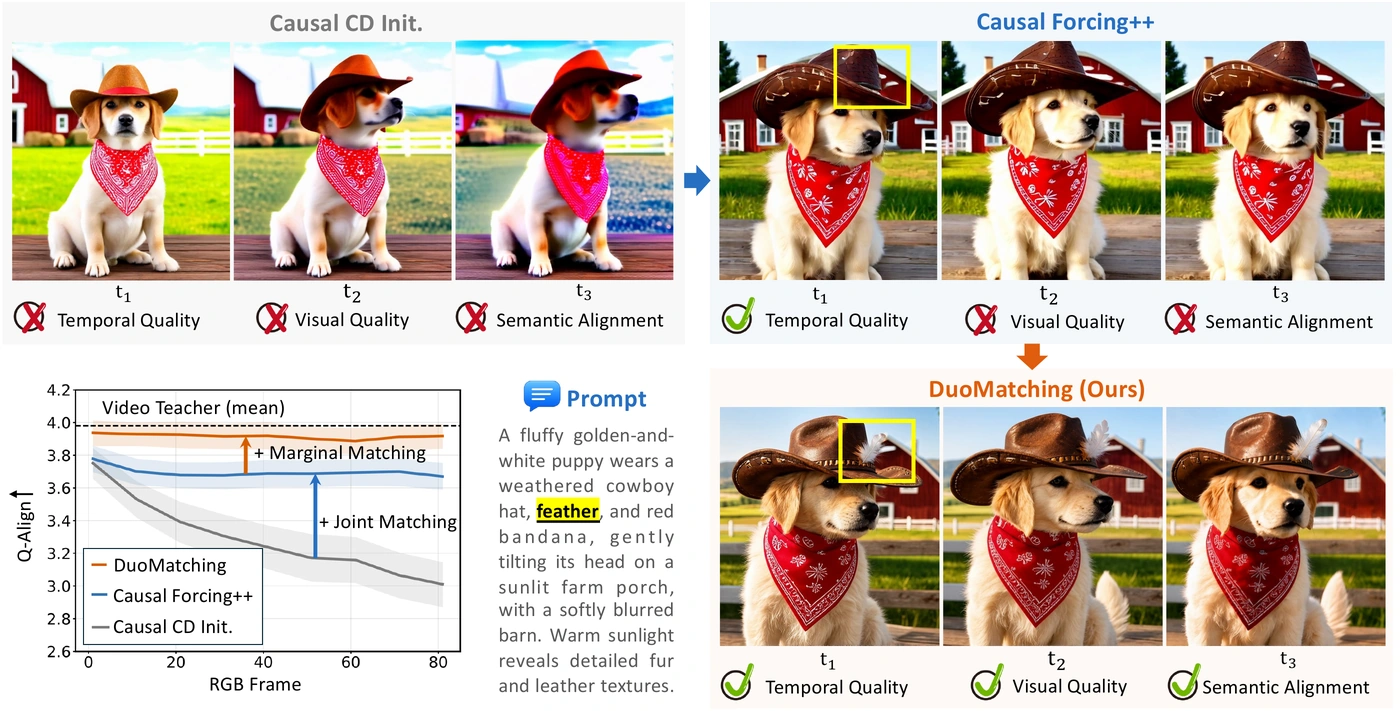
Streaming video generation has benefited from distribution matching distillation (DMD), which matches the joint distribution of video frames to a video teacher’s approximation of the real video distribution. Although this joint matching mitigates drift during autoregressive rollouts, limitations remain in visual quality and semantic alignment. To address these limitations, we propose DuoMatching, a distribution matching framework that approximates the real video distribution through a unified joint-marginal formulation. On top of existing joint matching formulations, the additional marginal matching objective provides dedicated frame-level supervision from an image generator, transferring complementary visual and semantic priors from it. To apply this frame-level supervision in video generation, we introduce LatentBridge to resolve the latent representation mismatch between the video student and the image teacher. Latent Variation Sampling further distributes such frame-level supervision across distinct temporal segments, reducing redundancy. Experiments demonstrate that DuoMatching improves visual quality, composition, and semantic alignment while largely preserving motion dynamics. Human evaluations show overall preference rates above 80% against all evaluated baselines.
Method
Joint-marginal matching with LatentBridge and Latent Variation Sampling.
Click the figure to expand the left panel and play the idea animation.
DuoMatching framework. Joint-marginal matching and the two designs that enable frame-level supervision in temporally compressed video latents.
View full-size PDF(a) Joint-marginal matching
Retain joint video supervision and add image-teacher supervision on frame-level marginals.
(b) LatentBridge
Map temporally compressed video latents to image latents for frame-level supervision.
(c) Latent Variation Sampling
Distribute frame-level supervision across distinct temporal segments using latent variation.
Comparisons with Baselines
We compare DuoMatching with Causal Forcing++, One-Forcing, Reward Forcing, and CausVid. Each pair uses the same number of function evaluations (NFE) for DuoMatching and the corresponding baseline. Select a baseline below to view the comparisons. Click either video to play or pause the pair.